2025-12-09
Laser-Induced Modulation, Vaporization; and Plasma Formation of Free-Flying Liquid Tin Sheets
Publication
Publication
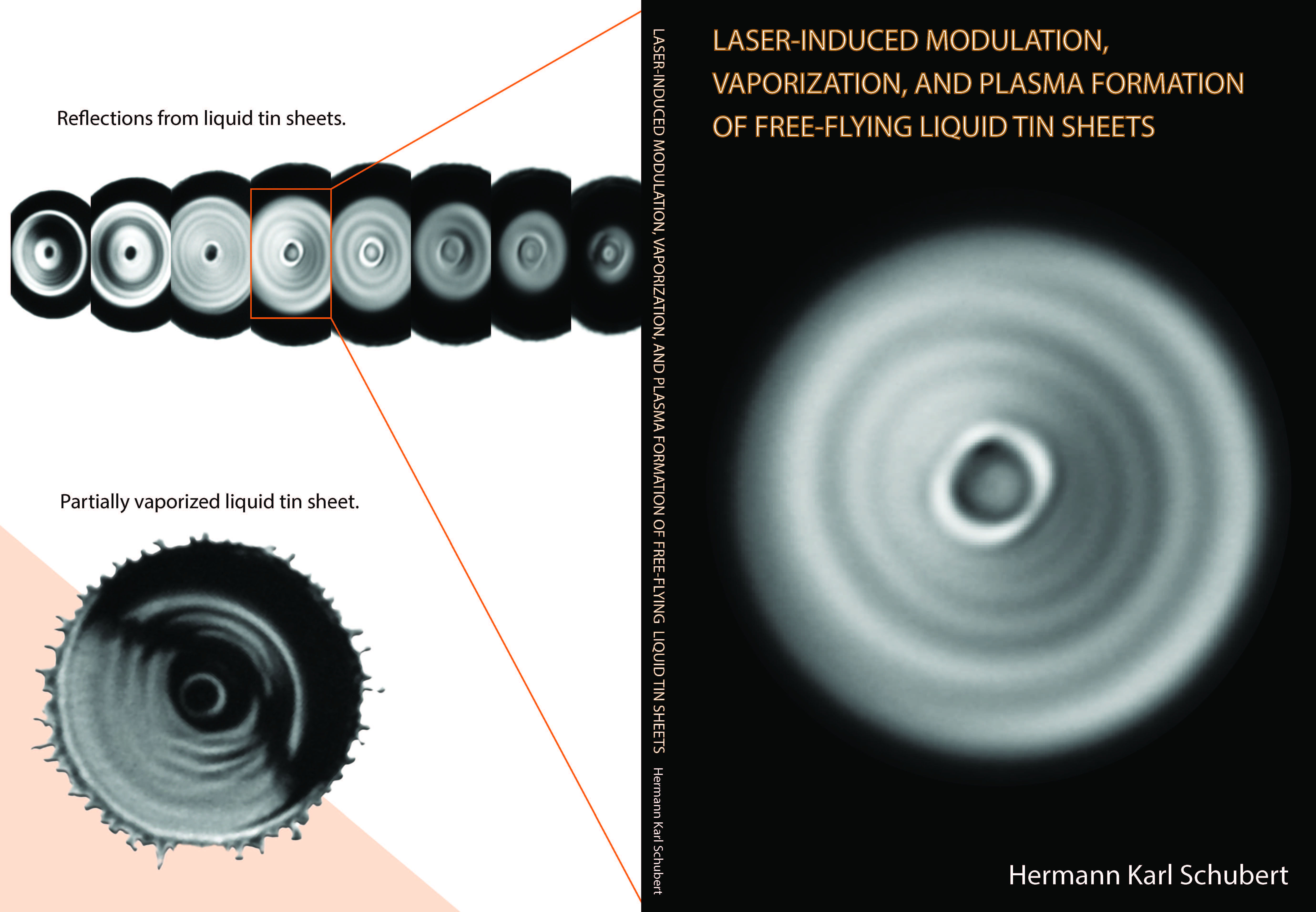
This thesis investigates laser–matter interactions that determine the dynamic response of liquid tin droplets and expanding sheets under pulsed laser irradiation. These processes are critical for optimizing target design in next-generation extreme-ultraviolet (EUV) nanolithography. The aim is to understand how liquid tin responds to the vaporization pulse (VP) and prepulse (PP), both of which shape the target before exposure to the main pulse (MP). Two central research questions guide the work: What mechanisms govern the interaction between a nanosecond laser pulse and a free-flying liquid tin sheet? What causes the surface modulations observed on expanding free-flying liquid tin sheets? A combination of time-resolved experiments and numerical models addresses these questions across four chapters. Chapter 2 examined the vaporization of flat liquid tin sheets under low-intensity VP irradiation (100 ns box pulse). Using 5 ns-resolution shadowgraphy and a 1-D thermal–vaporization model, the process was identified as gradual and governed by the Hertz–Knudsen equation. A linear relation between vaporization rate and laser intensity was found, ẋₕ = A·I_VP, with A = 1.0(3) × 10⁻⁷ m s⁻¹ W⁻¹ cm². Vaporization dynamics were driven solely by deposited fluence, and experiments agreed with simulations, confirming model predictiveness for laser-based target shaping. Chapter 3 explored plasma formation on expanding sheets at higher VP intensities. Plasma ignition was localized and thickness-dependent, first occurring at the sheet center and propagating outward once a critical breakdown threshold was reached. A characteristic inflection point in the photodiode transmission signaled plasma onset, scaling approximately as I_VP⁻². These results demonstrated localized plasma dynamics and emphasized the role of pulse shaping and intensity control in target design. Chapter 4 analyzed concentric surface modulations on laser-propelled tin sheets at intermediate Weber numbers. These symmetric, nanometric patterns matched predictions of the Rayleigh–Taylor instability model by Klein et al., which describes modulation growth and sheet breakup. The experiments validated this model in the pre-breakup regime and established the intermediate Weber number domain as a controlled setting for studying modulation evolution. Chapter 5 extended this work by varying droplet size, prepulse energy, and duration to probe the transition from concentric to azimuthal surface modulations. Azimuthal modes appeared at higher Weber numbers, initially overlaying outer concentric features. The transition was gradual and time-independent once formed, with a droplet-size-dependent critical intensity. These observations indicate a shift in dominant instability modes and deepen understanding of hydrodynamic instabilities in rapidly expanding sheets. Together, these studies show that laser parameters can be tuned to precisely control liquid-tin behavior. Vaporization and plasma formation depend on both intensity and local thickness, while surface modulation patterns reflect the interplay of laser fluence, Weber number, and droplet geometry. At low prepulse energies, stable concentric modulations occur; at higher energies, azimuthal modes emerge due to enhanced instabilities. In addressing the research questions: The VP–tin interaction is governed by local thickness and laser intensity. At low intensity, vaporization is fluence-driven; at higher intensity, plasma forms abruptly once a critical threshold is reached, initiating centrally and propagating radially on nanosecond scales. Surface modulations originate from Weber-number-dependent instability dynamics. Concentric patterns follow Rayleigh–Taylor behavior, while azimuthal modes dominate at higher intensities, marking a phase transition that is intensity- and size-dependent but time-independent once triggered. Overall, this work provides a unified framework for controlling liquid-tin targets through laser-parameter tuning. It advances understanding of vaporization, plasma onset, and hydrodynamic instabilities in laser-driven fluids, offering insights directly applicable to the stable and efficient design of EUV nanolithography targets.
| Additional Metadata | |
|---|---|
| O.O. Versolato (Oscar) , W.M.G. Ubachs (Wim) , J. Sheil (John) | |
| Vrije Universiteit Amsterdam, VU | |
| ASML, ARCNL, VU, UvA, RUG, NWO | |
| Organisation | EUV Plasma Processes |
|
Schubert, H. K. (2025, December 9). Laser-Induced Modulation, Vaporization; and Plasma Formation of Free-Flying Liquid Tin Sheets. |
|